

Child-led Learning
In Canada and the U.S., the number of homeschooled children has DOUBLED in the last 15 years! DOUBLED! Parents are acknowledging that their family’s values or their child’s learning style may not align with the traditional school system. Many parents want more time with their children and want to create a learning environment that nurtures their child’s natural curiosity.
Some families also recognize that by sending their child away for six hours a day, five days a week, they are entrusting their child’s learning, social & emotional development (and even their subconscious development,) to someone else entirely. Now, here me out… there are some truly AMAZING teachers out there, (you know who you are!) However, there are also teachers who are burnt out, nearing retirement, or simply don’t enjoy the job. It’s natural for parents to wonder if this arrangement will really be the best fit for their child. You might feel like you’re ‘rolling the dice’ on what type of teacher your child will get.

What is Child-led Learning and How Can it Benefit the Learner?
Looking for ways to tailor your child’s education to their interest?
Interested in new ways to foster more cooperation in the learning space?
Let’s get to it!
Hello and welcome to the Harmonious Classroom blog! Today, I want to talk about child-led learning: what it is and why it’s so valuable?
Child-led learning is an approach where children’s natural curiosities and passions guide what and how they learn. Instead of following a fixed curriculum, educators can tune into each child’s passions and create an engaging learning environment based on their interests.
So why is this approach so powerful? Well, when children get to choose what they want to learn about, or when learning is tailored to what already fascinates them, the learning REALLY sticks. It becomes meaningful, engaging, and enjoyable. Children develop a natural love of learning. And honestly… it encourages more cooperation too, because they genuinely want to be involved.
Think about it like this: as adults, we’ve all tried learning something we didn’t care about…maybe for work or another obligation. Chances are if you didn’t NEED to remember it, or you weren’t interested in it, it didn’t stick. Children are no different. If they aren’t engaged or curious, no amount of hands-on activities or carefully planned lessons will make the learning stick.
So, how can we use child-led learning to make education more valuable to the child?
When you embrace a child-led approach, you honour each child’s natural pace and interests. This opens up a wonderful opportunity for connection between educator and child. It gives the educator the opportunity to dive into the child’s world, exploring their interests together and letting the learning evolve from there. The children are more engaged, they learn more deeply, and the whole process feels joyful rather than forced.
Here’s a story about what happens when learning isn’t aligned with a child’s interests: When my daughter was three, I planned a hands-on lesson about maple syrup. We did a whole unit on trees & maple syrup. I took my kids out and tapped all ten maples in our front yard. I taught: tree identification, cardinal directions & how to use a compass, the purpose of sap weather and how it flows through the roots & trunk, and so on. Together we spent the early Spring collecting sap, boiling it and making our own small batches of maple syrup. It was a fully interactive and sensory-rich lesson! I thought it would be amazing! But one morning about three months later while we were having pancakes for breakfast my daughter asked, “Mummy, what animal does maple syrup come from?” My carefully planned lesson had completely not stuck. Why? Because she wasn’t genuinely interested in the tree tapping process. Even the most carefully articulated lesson won’t resonate if it doesn’t follow the child’s genuine curiosity.
Some of you know that I recently opened a self-directed forest school with a good friend of mine. (Check out Cedarwood to learn more!) So what does “self-directed” mean and how does it differ from child-led? Self-directed education takes child-led learning one step further. Here, educators not only follow the child’s interests, but the children are also given full responsibility for their learning. According to Self-Directed.Org “Education is the sum of everything a person learns that supports them towards living a satisfying and meaningful life.” They make choices about what, how, and when they will learn. Trust is fully placed in the child, allowing them to be the master of their life and their learning. We trust that children will learn when they’re ready and when it matters to them.
Now, here’s a story about the a child-led learning experience that truly took off: At my forest school, we had been making geo-boards with wooden disks, hammered in nails and elastic bands. One child began taking the elastic bands and weaving them like they did with their Rainbow Loom at home. She made this over-sized bracelet out of elastics. She kept talking about how good she is at rainbow loom and soon the word caught on. (For those who don’t know, Rainbow Loom is a set of mini elastics that can be woven together in different patterns to make bracelets, key chains and ornaments.) “Me too! I love rainbow loom!” Another child announced. We began to see that this is something the children were really interested in. To be honest, it was also a great fine motor activity and really prepares children for finger knitting and other hand work. So we decided to purchase our own set of Rainbow Loom and bring it into the space to see what would happen.
Suddenly, the children were all engaged. The older children taught the younger children. The younger children were so eager to learn from their older peers- because they could feel the passion and excitement that the older kids had embodied about this Rainbow Loom. So far the skills we’ve learned: following multi-step directions, learning from peers, attentive observation and fine-motor coordination.
Then, one of the older children told us, “I have a rainbow loom at home that I’ve been working on for months and it’s probably longer than all of us put together.” The response from the others was “No way! That’s not possible.”
Well, it turns out it IS possible. The next day the child brought in his GIANT rainbow loom chain, and I must say- it probably could set a world record. It was so long that it just HAD to be measured. We were all fascinated. From here, the learning TOOK OFF.
We got out our notebooks and everyone made an estimation of how long this rainbow loom was. 30ft? 50ft? 100ft?
We all wrote down our estimates. Next, we got out our measuring tape. EVERY child was so eager to work together to measure this and figure out just how long it was. The only problem was the measuring tape was only 12ft long! We quickly got a clipboard to keep track of the measurements. The older kids came up with a solution: lock the tape at 12 feet and move it along, tallying 1 each time they slide the tape forward. In the end, the loom chain stretched 12 feet, 6 times, plus another 3 feet. This lead us to some math equations!
The children broke it down:
12ft X 6 = 72ft
72ft + 3ft = 75ft!
A 75ft long elastic chain!
From here, we needed to see whose estimation was the closest. So it was time to subtract.
100ft - 75ft = 25ft
75ft- 50ft = 25ft
75ft- 30ft =45ft
From this Rainbow Loom adventure the children learned:
How to teach others, how to observe and ask questions, fine-motor coordination, problem solving skills, how to make an accurate estimation, addition, subtraction, multiplication, and more! SO much learning took place naturally, all sparked form a shared interest in Rainbow Loom.
Want to learn practical ways to bring a child-led approach into your learning environment?
Join the FREE webinar today - HERE
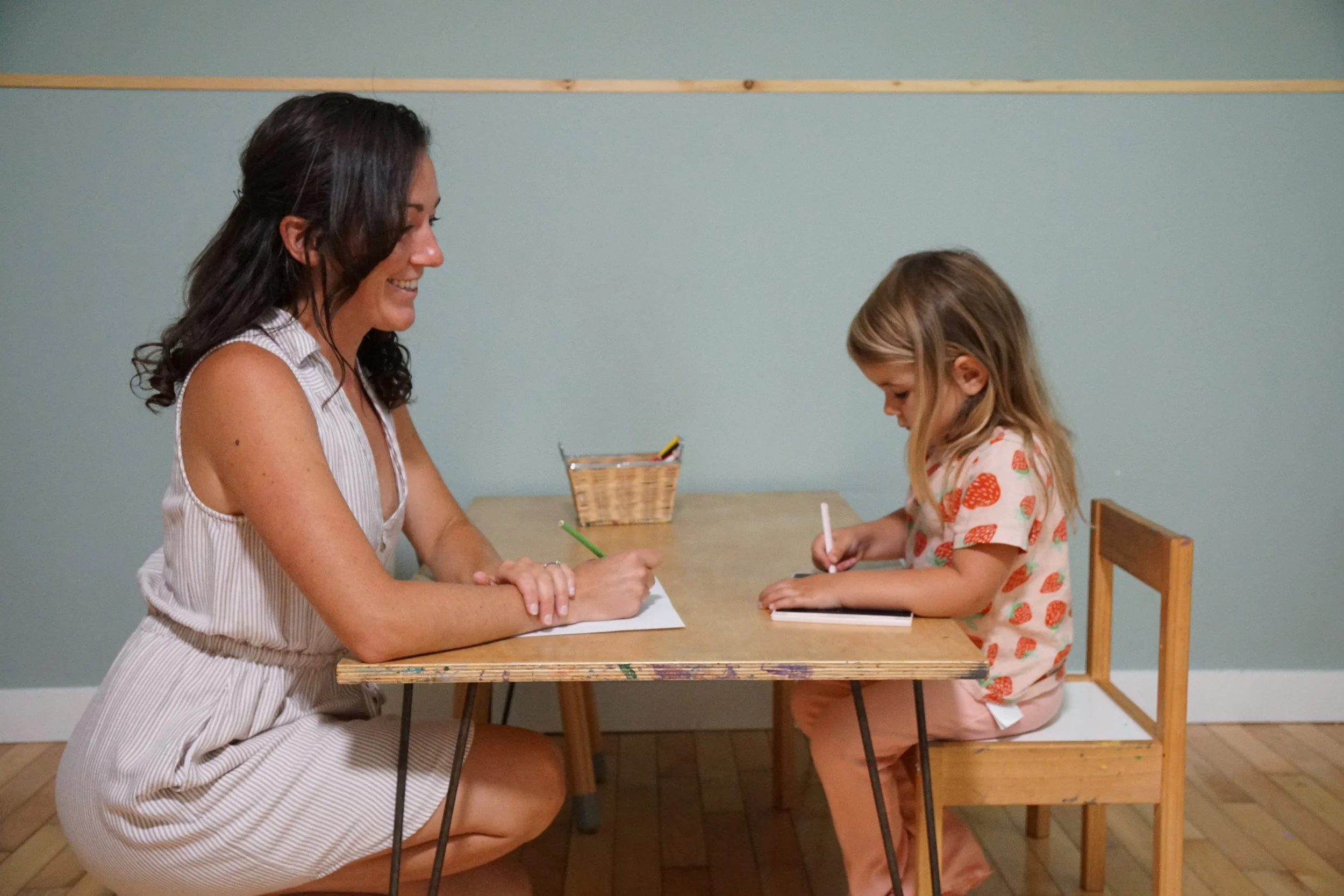
Have questions about how to bring a child-led approach into your teaching model?
I offer 1:1 consulting that you can book right here.
Homeschool Curious
In Canada and the U.S., the number of homeschooled children has DOUBLED in the last 15 years! DOUBLED! Parents are acknowledging that their family’s values or their child’s learning style may not align with the traditional school system. Many parents want more time with their children and want to create a learning environment that nurtures their child’s natural curiosity.
Some families also recognize that by sending their child away for six hours a day, five days a week, they are entrusting their child’s learning, social & emotional development (and even their subconscious development,) to someone else entirely. Now, here me out… there are some truly AMAZING teachers out there, (you know who you are!) However, there are also teachers who are burnt out, nearing retirement, or simply don’t enjoy the job. It’s natural for parents to wonder if this arrangement will really be the best fit for their child. You might feel like you’re ‘rolling the dice’ on what type of teacher your child will get.
Is Homeschool The Best Option For Your Child (A Complete Guide To Choosing The Right Option!)
Maybe you have a child approaching school age and you’re wondering if traditional school is the right fit.
Or, perhaps your child is already in the school system, but something isn’t quite working, and you’re considering shifting to a homeschooling journey instead.
Let’s break down all of your options!
Homeschool Curious?
Hello and welcome to The Harmonious Classroom blog! This post is for the homeschool curious. So, you’re interested in homeschooling but there are still SO many hesitations and uncertainties floating around in your head.
Maybe you have a child approaching school age and you’re wondering if traditional school is the right fit. Or, perhaps your child is already in the school system, but something isn’t quite working, and you’re considering shifting to a homeschooling journey instead.
Today, we’re going to talk about what homeschooling really is, clear up some common misconceptions, and explore why it’s growing in popularity.
What Is Homeschooling?
Homeschooling is when your child learns at home rather than attending a traditional or private school. That’s it.
Despite its simplicity, there are plenty of misconceptions. Some of the most common misconceptions are:
Homeschooled children don’t get proper socialization
I’m not qualified to homeschool because I’m not a trained teacher
I have to purchase a curriculum and spend hours a day teaching my child.
Let’s unpack these and explore the real story.
Why Is Homeschooling Growing in Popularity?
In Canada and the U.S., the number of homeschooled children has DOUBLED in the last 15 years! DOUBLED! Parents are acknowledging that their family’s values or their child’s learning style may not align with the traditional school system. Many parents want more time with their children and want to create a learning environment that nurtures their child’s natural curiosity.
Some families also recognize that by sending their child away for six hours a day, five days a week, they are entrusting their child’s learning, social & emotional development (and even their subconscious development,) to someone else entirely. Now, here me out… there are some truly AMAZING teachers out there, (you know who you are!) However, there are also teachers who are burnt out, nearing retirement, or simply don’t enjoy the job. It’s natural for parents to wonder if this arrangement will really be the best fit for their child. You might feel like you’re ‘rolling the dice’ on what type of teacher your child will get.
Curriculum and Teaching
One misconception is that homeschooling must mirror traditional schools. Some families choose to buy a curriculum online, set up a table space, and expect their child to sit and learn for several hours a day. But let’s take a second and think back… why did you consider homeschooling in the first place? Was it because traditional school didn’t fit your child’s learning style, or because you didn’t want their creativity stifled?
Here’s the truth: you don’t have to mimic the school system. One of the biggest advantages of homeschooling is FLEXIBILITY. Learning can take place at any time and in any way. Children are learning all the time…through conversations, play, cooking, nature walks, library trips, community activities, and even household chores.
If you do want to follow a curriculum, that’s perfectly fine. Homeschooling is about what works for your child and your family. It’s not necessary to recreate the public school system at home.
For a deeper dive on curriculums check out… Do You Really Need a Curriculum?
But I’m not a teacher…
You might worry, “I don’t think I can homeschool because I’m not a teacher.” Let’s take a minute to remember that from the moment of birth, YOU have been your child’s first teacher. Think back to the first time that your baby learned to clap their hands, or say ‘mama’... they likely learned it from imitating YOU.
Now, I hear the concerns… “Yeah, Laura I can teach a baby to say ‘Mama’ but I don’t think I can teach my kids long division.”
I get it. There’s a difference.
If teaching doesn’t come easily to you, please know that it’s totally okay to learn alongside your child. Often with homeschooling, you are learning with your child, instead of just ‘teaching’ them everything that you already know. Learning alongside your child gives them an advantage- you can really take some time to tune into your child’s unique learning style. You can explore different approaches and understand how they learn best. You can even both learn (or re-learn) new concepts together.
You don’t have to do it all alone. Consider creating a learning network for your child by inviting community members or local experts to help: maybe it’s a neighbour passionate about woodworking, an elder who loves story telling, or a local high schooler who excels in math and is looking for some volunteer hours. This expands learning opportunities and reduces pressure on you.
Keep in mind that in a traditional Kindergarten classroom with around 20 children, most of the day is spent on classroom management, transitions, hand washing, and navigating conflicts. In fact, there is usually less than an hour of academic learning each day. This means that at home, especially in the early elementary years, just an hour or two of focused, direct teaching per day is typically all that’s needed. If you follow a self-directed learning approach, your role is mainly to observe, guide, and step in when there is an appropriate invitation to teach a new concept or skill.
Community and Socialization
Socialization is another common concern that people have about homeschooling. Many people assume that simply being around other children at school gives kids enough time to socialize. In reality, most of their day is teacher-directed, leaving very little time for genuine, child-led social interaction.
Humans are designed to live, learn, and grow in groups, but separating children strictly by age isn’t really natural. Children can, and do, learn from people of ALL ages. Socialization isn’t just about spending time with peers who are in the same grade as you.
Mixing ages can actually be a better way to socialize children. Younger children look up to older peers who have already mastered skills they are trying to learn, while older children can develop leadership and care-giving skills by mentoring younger ones. Socialization isn’t just about other children either; it’s also important for children to learn to interact confidently and respectfully with adults too. Socializing is learning how to be a part of, and interact within a community.
Homeschooling provides unique opportunities for daily integration into society. Your child might:
Check out books independently at the library
Order food at a restaurant or pay for something by themselves
Go to the post office and send a letter to a friend
Every opportunity to engage within society helps your child to learn social skills and develop independence in real-world settings.
The Big Picture
Homeschooling is about creating a learning environment that works for your child and your family. Let it be flexible. You don’t need to replicate the school system, and you don’t need to be a certified teacher. You simply need to show up, observe, guide, and learn alongside your child.
If you’re homeschool curious, take your time exploring, asking questions, and discovering what works for your family. There’s no single “right” way to do it. You’ve got this!
Have questions that you want answered about Homeschool vs. Traditional School?
I offer 1:1 consulting that you can book right here.
Do You Really Need a Curriculum? A Fresh Perspective on Home Learning
It all begins with an idea.
Hello and welcome!
I’m Laura, the founder of The Harmonious Classroom. I created this space as a supportive place for homeschooling parents, educators, and anyone interested in teaching, self-directed learning, or alternative approaches to education.
Today, I want to talk about a question I hear all the time in homeschooling communities: “What’s the best curriculum out there?!” This is especially common among parents with preschoolers or kindergartners who are excited and anxious to get started with homeschooling.
Many families use a curriculum successfully, and that’s great! Every parent knows their child best, and whatever works for your family is the right choice for you. But I want to offer an alternative perspective: do you really need a curriculum at all?
Rethinking Learning
For some parents, the idea of teaching without a structured curriculum can feel overwhelming. You might think, “I’m not a teacher, how will my child learn to read, write, or do math if I don’t have a guide?”
I understand this feeling. I spent years as a school teacher, writing lesson plans and carefully following the set curriculum. And honestly? Many of those lessons didn’t reach learners the way I hoped. Some students weren’t interested, and others didn’t engage because things didn’t go as planned. This experience opened my eyes to a different approach to learning.
Many of us (myself included) were trained to think of learning in tidy little boxes: literacy from 9 to 10, math from 10 to 11, science after lunch. We followed lessons from a book or a curriculum, and our learning was compartmentalized.
But children don’t naturally learn that way, especially in the early years. Children are actually learning all the time, whether we guide them or not. And the good news? This means the pressure is really off. Learning doesn’t have to happen in structured lessons. It can happen naturally, all the time, through everyday life.
Everyday Life as Curriculum
When we homeschool and children participate in everyday life with us, they are learning constantly simply by observing and participating in real-life experiences. From measuring ingredients & following a recipe book while cooking, to counting and sorting laundry, to reading labels or exploring nature…. children are developing literacy, math, science and problem-solving skills through hands-on, real life activities. When we are attentive to their natural curiosity and follow their interests, we create a rich learning environment where a formal curriculum isn’t always necessary. Learning is simply INTEGRATED into everything we do.
Let’s take a three- to five-year-old as an example. You might be wondering if you need a workbook to teach letters and shapes. But let’s say you’re spending intentional time with your child….observing, guiding, and engaging in life together. Every moment can become an opportunity for learning.
Imagine walking to the playground. Your child points to a stop sign and says, “Stop!” You lift them up and trace the letters on the sign together: S, like a snake. You make the sound together. Suddenly, your child is learning literacy in a hands-on, meaningful way. This learning sticks because it’s connected to their life and interests, not just a page in a workbook.
Or take mathematics for example. Recently, my six-year-old and I were faced with a pile of 100 planks of wood for a forest school cabin we’re building. My son gasped at the enormous pile and asked how many trips it would take to move all of the planks into the forest. We counted, sorted into piles of ten, and calculated together. “If we carry ten boards at a time, and have ten piles of ten, then it will take 100 trips!” He had just explored grouping, counting, and multiplication - all without a worksheet. He came up with the question himself, and we seized the natural opportunity to teach him.
Learning like this happens everywhere: cooking, folding laundry, exploring nature, or even reading together. The more we tune in to our child’s curiosity and natural desire to learn, the more willing and engaged they become.
Let’s take science for example. Science is another subject that is naturally embedded into everyday life. Take your child outside - you’ll see science all around. Count leaves, explore symmetry in ferns, or investigate insects under rocks. Curiosity drives learning, and when we follow their lead, lessons happen organically, without formal instruction.
Let the child take the lead and you step in thoughtfully as the guide when teaching can enhance the experience.
A New Perspective on Curriculum
Before getting caught up in which curriculum is “best,” I invite you to consider this: what if childhood itself IS the curriculum? This approach, called self-directed learning, can be implemented at any age. It’s when we let the children’s interest take the lead for their learning. As the educator or parent, we follow the child’s lead and look for invitations throughout the day to teach them new things that are meaningful in their life.
If you’re just starting out, I encourage you to explore this perspective. Trust that your child is learning constantly, and that you don’t always need a structured program to guide them. They will learn everything they need to, in their time.
Thank you for reading!